
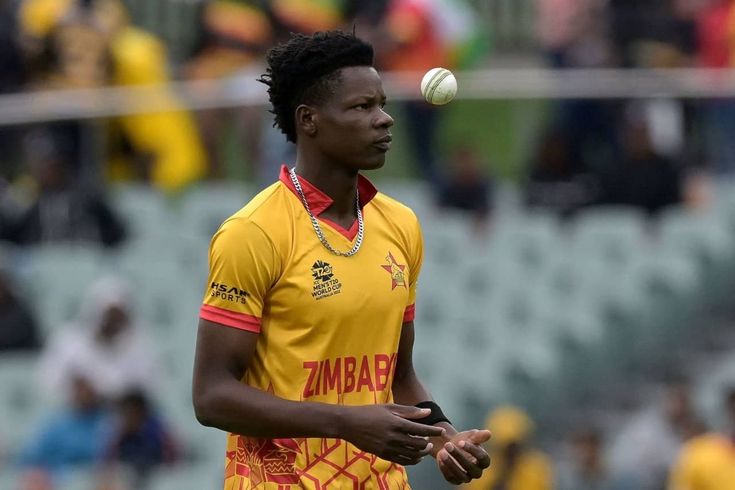
There is something strange about tall fast bowlers. You notice them before they bowl a ball. Before the speed gun flashes. Before the first bouncer climbs toward a helmet. Before the commentator says their name. You notice them just standing there. Blessing Muzarabani too has that presence.
Six foot eight. Long arms. Quiet face. The kind of fast bowler who doesn’t try to look intimidating, but somehow is. And yet, his story doesn’t begin in packed stadiums or headline matches. It begins somewhere much quieter. It begins with absence. Zimbabwe cricket slowly fading from prime-time relevance. Fewer tours. Fewer headlines. Fewer guarantees. And somewhere inside that silence, a fast bowler was learning how to carry weight.
Chapter 1: A Fast Bowler From a Country That Stopped Trending
If you grew up watching cricket in the early 2000s, you would know Zimbabwe was not a small team.
They beat big sides. They produced stubborn batters. And occasionally, bowlers who made bigger teams uncomfortable. Then, slowly, they disappeared from relevance. Not from cricket. From conversation.
Financial issues. Administrative chaos. Political interference. Series cancelled. Tours reduced. Coverage vanished.
Zimbabwe cricket didn’t die.
It just stopped being talked about. And in that silence, a tall fast bowler was growing up.
Blessing Muzarabani did not grow up in a system full of academies and sponsorships.
He grew up in a system trying to hold itself together. When you come from such a place, becoming a fast bowler is not just about skill.
It’s about stubbornness. Because you’re not chasing fame. You’re chasing continuity
Chapter 2: The First Thing People Notice
When Muzarabani first started appearing in international games, most reactions were the same:
“Who is this tall guy?”
“6’8”? Seriously?”
“That bounce is awkward.”
Height is a gift for fast bowlers. But it is also a burden. Because once people notice your height, they expect fear. They expect dominance. They expect immediate impact.
And if you’re not from Australia, England, or India, they expect you to disappear quickly.
But Muzarabani didn’t disappear. He kept showing up in scorecards. Quietly. Consistently. Without drama. No viral send-offs. No aggressive celebrations. Just a tall fast bowler doing his job.
That quiet consistency began to build something more powerful than hype: reputation.
Chapter 3: The Bloodline of Fast Bowling
Fast bowling travels through generations like folklore. Every era has its symbol.
There was a time when Michael Holding ran in like poetry.
Smooth. Silent. Deadly accurate.
They called him Whispering Death because the danger arrived before the noise did.
Then came Mitchell Starc — a different kind of fast bowler.
Left-arm, sharp, ruthless in tournaments.
The kind who could change a World Cup game in two overs.
Then Jasprit Bumrah — the anomaly.
Short run-up. Unusual action.
A fast bowler who made precision look more intimidating than aggression.
Different countries. Different eras. Different styles.
But all of them carried one thing: the responsibility of being their team’s fast-bowling identity.
And that’s where Blessing Muzarabani quietly joins the lineage.
Not because he’s identical to them.
But because he carries the same burden, just without the same spotlight.
Chapter 4: Bowling Fast Without a Safety Net
Here’s the difference between being a fast bowler in a big team and a rebuilding one.
If Starc has a bad day, Australia still has depth.
If Bumrah rests, India has a bench full of quicks.
If Holding had an off spell, West Indies still had four others coming at you.
If Muzarabani has a bad day?
Zimbabwe feels it immediately.
That’s the reality of being a lead fast bowler for a smaller cricketing nation.
You’re not just part of the attack.
You are the attack.
Every spell carries expectation. Every wicket changes momentum more dramatically. Every good performance keeps your team competitive. And yet, the world doesn’t always watch.
Imagine bowling your heart out in a spell that deserves headlines — and waking up to see it barely mentioned. That is a different kind of mental test. Fast bowling is already lonely. Doing it without global noise makes it lonelier.
But sometimes, that loneliness builds character instead of breaking it.
Chapter 5: The Personality Behind the Height

Watch Muzarabani closely and you’ll notice something. He doesn’t behave like a fast bowler desperate for attention. He behaves like one comfortable with patience.
There’s no theatrical aggression. No constant sledging. No exaggerated persona.
Just a calm face. A long run-up. And effort that repeats itself ball after ball. Some fast bowlers perform for the crowd. Some perform for moments. And some, like him, perform for continuity.
That personality matters when you’re representing a team trying to rebuild its place in world cricket. Because rebuilding doesn’t happen through one magical series. It happens through players who stay. Who keep showing up. Who keep delivering even when the spotlight is not guaranteed.
Chapter 6: Why His Story Feels Different
In a sport obsessed with noise, Muzarabani has chosen substance.
There are faster bowlers in the world. More famous ones. More marketable ones. But not many carry this particular narrative. A fast bowler from a team outside regular global dominance. Playing modern cricket with old-school patience. Carrying expectations without demanding attention.
He represents something cricket doesn’t always market well: persistence without drama.
And that’s why his story feels fascinating. Because it’s not built on one viral spell or one historic match. It’s built on the slow, steady act of refusing to fade away.
Chapter 7: Where Persistence Becomes Legacy
Somewhere in the next few years, a young fast bowler will emerge from another country not always in headlines. He’ll be tall. Or quick. Or unusual.
And someone will say,
“He reminds me of…”
That’s how fast bowling generations continue. Through resemblance. Through influence. Through memory. Blessing Muzarabani may not dominate headlines like some of the greats before him. But he stands in that same timeline. A fast bowler running in from a place that cricket sometimes forgets, reminding the game that pace doesn’t only belong to powerful teams. Sometimes, it belongs to those who keep running in even when the world isn’t fully watching yet.
For more thoughtful stories and deep dives, visit our sports section.